



Managing Water Quality Compliance:
“No-Discharge” Reality
Quick Summary
- Nurseries are increasingly turning to runoff water capture and recycling in response to water scarcity and state "no discharge" regulations.
- Diverting water with swales, berms, and channels can help direct water flow to prevent runoff and erosion.
- Water can be reclaimed in detention and retention basins before treatment (ex. filtration & disinfection) and reuse in the nursery.
As water scarcity and state regulations challenge California’s horticultural industry, many nurseries are turning to recycled runoff water as a primary or supplemental water source. While a “no-discharge” reality presents logistical hurdles, it also offers an opportunity to improve resource efficiency, however careful management must be taken not to spread chemical and biological contaminants throughout your property and into neighboring properties.
The Regulatory Landscape
In California, the Irrigated Lands Regulatory Program (ILRP) serves as a primary mechanism for protecting surface and groundwater from agricultural runoff. Managed by the State Water Resources Control Board, the ILRP regulates discharges from commercial irrigated lands to prevent pollutants such as pesticides, fertilizers, and pathogens from impairing surface and groundwater.
Each region has their own compliance methods and allowable exemptions, so it is important to check your region-specific information (State Water Board, 2026). As an example, Region 9, which covers much of San Diego County designates that discharging irrigation runoff is prohibited, including runoff that is completely free of pollutants. Discharging rainwater is allowed, but the discharge must not contain sediment, nutrients, pesticides, or trash. Region 9 nurseries must manage runoff carefully through proper irrigation, or by capturing and containing runoff. (County of San Diego Department of Agriculture, Weights and Measures, 2021)
Your strategy comes down to two choices:
- Prevent runoff through irrigation and site management.
- Collect runoff and repurpose it throughout your nursery.
Physical Runoff Management
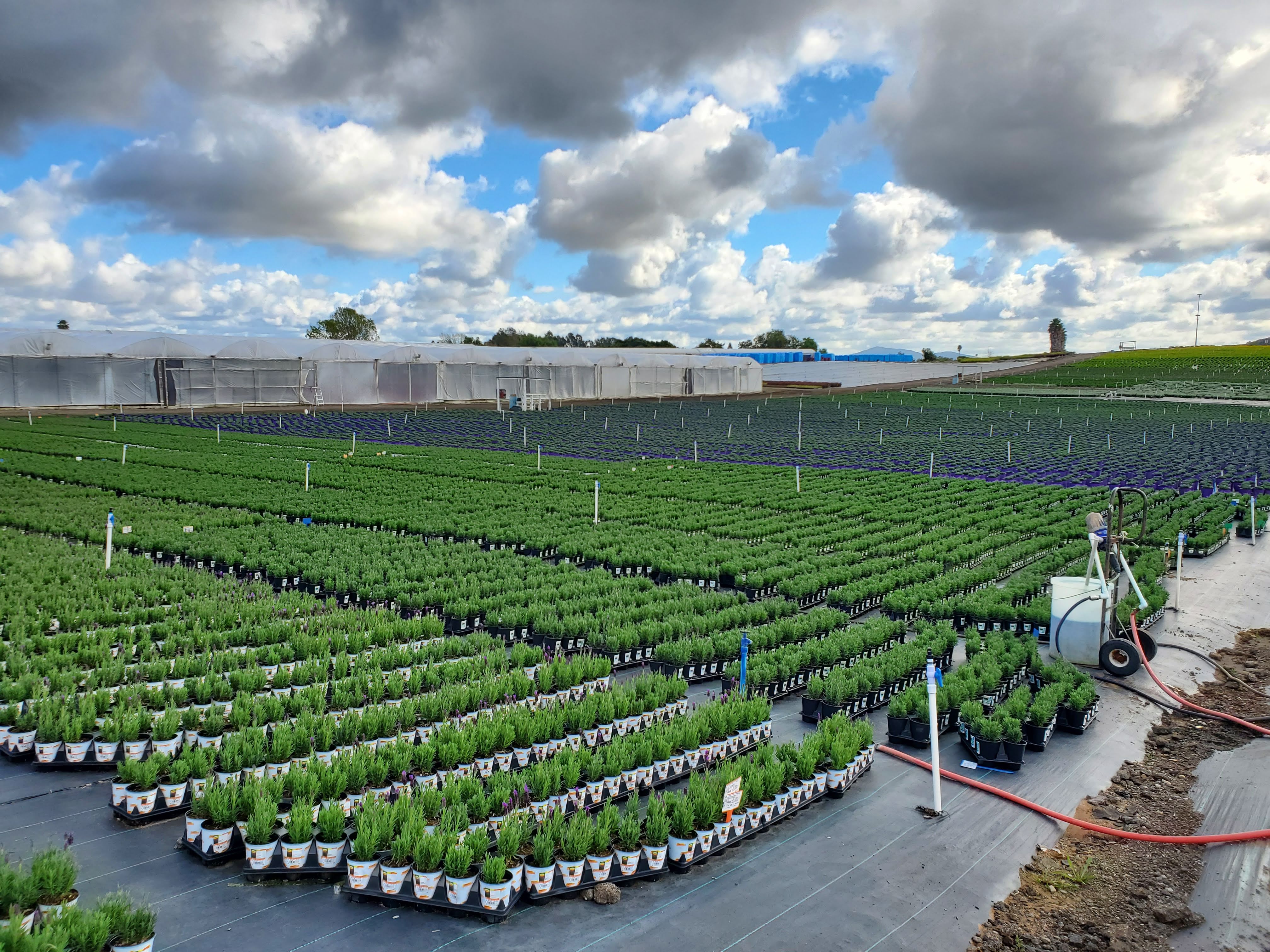
Preventing runoff and stormwater from leaving your property is the first step. Even with refining irrigation systems to reduce runoff, heavy rain can cause erosion that discharges sediment. Careful observation of potentially problematic sites such as low-lying areas and impervious surfaces during rain events is your starting point in implementing solutions. To reduce erosion, slow down the flow of water. This can be done by diverting water through to swales or by including wattles in runoff channels. Additionally, building berms and channels to direct water flow to where you want it to go can help. Often, nurseries divert runoff into a basin to store any excess runoff.
Weed barrier cloth is beneficial to reduce soil erosion and is typically laid flat on the ground in growing areas or within channels. Not only does this fabric help direct water where you want, but it also helps prevent weeds and maintains a clean work surface. Further resources on stormwater runoff strategies can be found in the article “How to manage water runoff in your nursery” by UCANR advisor, Gerry Spinelli.
Stormwater Basins

There are two types of stormwater basins: retention basins and detention basins. Detention basins are designed to hold stormwater temporarily, refilling only during rainfall events so that excess runoff does not leave the property. Installing catch basins to settle out sediment before stormwater leaves your property is a good strategy.
A retention basin holds water in a permanent pool which can be used to capture, contain, and treat nursery runoff so that it remains on-site. Retention basins can be lined with polyethylene plastic liners, butyl pond liners, or concrete to prevent stored water from infiltrating into the soil. If recycling captured irrigation runoff water back into your irrigation supply is not preferred, this water can be applied to keep down dust from dirt and gravel roads.
Treating Captured Runoff

Reusing runoff introduces the challenge of managing waterborne plant pathogens such as Phytophthora, Pythium, and Fusarium, as well as residual nutrients and agrochemicals. A “one-size-fits-all” approach does not exist; instead, effective management depends on combining multiple treatment methods into a best management practice (BMP) treatment train. Typical components include:
- Settling and sedimentation ponds that provide initial clarification before advanced treatment.
- Physical filtration (e.g., sand filters, screen filters) to remove particulates and organic debris.
- Disinfection technologies such as ultraviolet (UV) radiation, ozonation, or chlorination to inactivate pathogens.
- Biological systems like constructed wetlands or slow-sand filters that use microbial communities to degrade contaminants.
Regular water testing for pathogens and chemical residues will verify treatment effectiveness and support compliance documentation under ILRP reporting.
References
California State Water Resources Control Board. (2026, February 2). Agriculture. https://www.waterboards.ca.gov/water_issues/programs/agriculture/
County of San Diego Department of Agriculture, Weights and Measures. (2021, July). Agricultural water quality best management practices (BMPs). https://www.sandiegocounty.gov/content/dam/sdc/awm/docs/AG_BMP_EN.pdf
Padilla, Robert. "How to Manage Water Runoff in Your Nursery." University of California Cooperative Extension, San Diego County, edited by Gerry Spinelli, Production Horticulture Advisor, UCCE. https://ucanr.edu/county/ucce-san-diego-county/how-manage-water-runoff-your-nursery
Haver, D. (2004). Sediment Management Goals and Management Practices: Nursery and Floriculture (ANR Publication 8124). University of California Agriculture and Natural Resources. https://anrcatalog.ucanr.edu/pdf/8124.pdf