UCNFA Summer Issue 2026

In the Summer 2026 issue of the UCNFA Newsletter, the Featured Article provides interviews with three long term fixtures in Florida’s tree grades and standards program as momentum builds around similar efforts in California. The first article in Science to the Grower explains how to measure evapotranspiration (ET) and use ET values in greenhouse settings. Our second article in Science to the Grower explains how supplemental lighting can improve crop uniformity and shorten production cycles.

Greenhouse Evapotranspiration

Evaporation and Transpiration

Evaporation is the process by which water turns into vapor from a surface. After an irrigation or precipitation event, water evaporates from the growing media, soil, and wet plant surfaces. Conversely, transpiration refers to water traveling through a plant’s roots and vascular system and turning into vapor inside the leaf mesophyll, before leaving to the atmosphere through stomata.

Supplemental Lighting for California Nursery Production:

In California nursery production, light is one of the most important environmental factors influencing crop timing, plant quality, and uniformity. While the state is known for high annual solar radiation, many greenhouse operations still experience periods, especially from late fall through early spring, when natural light is not sufficient to meet the needs of certain crops. Shorter day lengths, frequent coastal fog, and prolonged cloudy periods can significantly reduce Daily Light Integral (DLI), particularly in propagation and liner production systems. 

The Use and Storage of Controlled Release Fertilizers in Nursery Production

Controlled release fertilizers (CRF) are granular fertilizers that have been coated with sulfur or a polymer. These products have been developed to allow a slow release of nutrients into the root zone throughout crop development.  In the following article we will describe several characteristics of CRFs that should be understood and various cultural practices that should be implemented to optimize nutrient use and minimize nutrient leaching when CRFs are used as part of a fertilization program.

New Thrips Species Found in Ventura, San Diego, and Santa Barbara Counties

The California Department of Food and Agriculture confirmed the presence of Hercinothrips dimidiatus, also known as aloe thrips, in Ventura, San Diego, and Santa Barbara counties. The CDFA assigned aloe thrips a B rating, which means they determined the pest is of known economic or environmental detriment. B-rated pests can enter the state if the receiving county agrees to accept them. You can read more about B-rated pests here. 

Learning in the Field

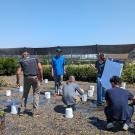
One of the strengths of UC Cooperative Extension is that each advisor’s program is grounded in local conditions while still benefiting from collaboration across the state. There is a great deal to learn simply by observing how experienced advisors approach their work.

UCNFA Spring Issue 2026

In the Spring 2026 issue of the UCNFA Newsletter, the first Featured Article highlights the irrigation education priorities for nursery employees that were identified by focus groups of California nursery managers. In our second Featured Article, a summary of California’s floriculture and foliage industry from the USDA 2022 Census of Agriculture is presented. In Science to the Grower, researchers from Cal Poly SLO describe how monitoring fungicide effectiveness can help control powdery mildew in Brassica seedling production.

Focus Groups of California Nursery Managers Identified Education Priorities for Irrigators

Introduction

California’s nursery and greenhouse industry relies heavily on irrigation, and extended droughts, such as the 2012–2016 drought, highlight the critical need for efficient water management. While soil moisture sensors could optimize irrigation, the cost of installing thousands of sensors makes this approach prohibitive for many operations. Training employees in irrigation best management practices could offer a more cost-effective solution.

Evaluating Fungicide Sensitivity in Downy Mildew:

Nurseries supplying Brassica transplants face immense production challenges due to downy mildew, caused by the Oomycete pathogen Hyaloperonospora brassicae. Large-scale monoculture plantings at different growth stages, dense planting spacing, and overhead irrigation, consistently contribute to high downy mildew incidence and large quantities of downy mildew inoculum. Moreover, the cool climate and nighttime moisture of California’s Central Coast create optimal conditions for infection in outdoor nursery spaces and grower plantings.

Soil and Water pH - Part 5

Soil and Water pH

Part I – What is pH?

Part II – How is nutrient availability affected by pH

Part III – How do fertilizers affect pH?

Part IV – How to adjust pH of soils

Part V – How to adjust pH of irrigation waters

The process of adjusting irrigation water pH is the process of changing the amount of H+ or OH- ions that are dissolved in the water.  In most cases where water pH modifications are required, it is to lower pH rather than increase pH. 

Cottonseed Bug In Southern California Nurseries

Cottonseed bug (Oxycarenus hyalinipennis) is an invasive pest that was first detected in Los Angeles County in 2019 and has since spread across most of Southern California. It can now be found in San Diego, Orange, Riverside, Los Angeles, Santa Barbara, and San Bernadino Counties. Cottonseed bug (abbreviated CSB) primarily feeds and reproduces on malvaceous hosts like cotton, hibiscus, and mallows, but can also be found feeding on a wide variety of other plants from wheat to citrus. CSB feeding can cause seeds to abort and will occasionally damage fruit or young shoots.

Bringing the lab to the field:

Phytophthora pathogens cause root and crown rots in many ornamental species and are a recurrent challenge in nursery production. These pathogens greatly affect plant health, resulting in devastating losses to the nursery industry, and have the associated risk of releasing pathogens of regulatory concern into trade and natural ecosystems. Efforts to control pathogen spread are costly, and as such, developing reliable and fast diagnostic tools to prevent and monitor pathogen introduction into nursery production is key. 

UCNFA Fall Issue 2025

In this Fall 2025 issue of the UCNFA Newsletter, our Featured Article discusses current ongoing research evaluating the pathogen risks of irrigation with untreated recycled irrigation water on ornamental crops in San Diego County, including preliminary findings and potential grower implications. In Science to the Grower, we introduce an improved metric for measuring greenhouse light levels, Photosynthetic Photon Flux Density, to more accurately adjust lighting for optimal crop production.

Evaluating the Pathogen Risk of Implementing Recycled Irrigation Water in Ornamental Crops in San Diego County

Water scarcity continues to challenge California’s floriculture industry, leading many nurseries to rely on recycled irrigation water as a supplemental or primary water source. Although this approach conserves water, it also increases the risk of recirculating plant pathogens, particularly oomycetes such as Phytophthora, Pythium, and Phytopythium. These organisms move easily in water and can initiate new disease cycles each time crops are irrigated.